The Goliath Tigerfish: The Monster of the Congo River
Welcome to the Congo
Welcome to the Democratic Republic of Congo, the setting of your upcoming fishing adventure. Congo is one of the greenest countries in Africa and home to deep jungle, marshland, mighty rivers and an abundance of wildlife such as elephants, chimpanzees, gorillas and much more. It is one of the wildest and most impenetrable places on the continent and home to the mighty Congo River, which takes us through the forest among hidden villages with forgotten tribes and mythical animals such as the okapi and the bonobo. It is also home to one of the most feared and sought-after game fish in the world: the goliath tigerfish, called Mbenga in the local language.
Some of the local fishermen see the goliath tigerfish as an evil spirit as it has been known to attack people. With its ugly mouth full of sharp teeth it definitely gives a scare when you coincidentally cross it!
There are several places in Congo-Kinshasa (DRC) where you can find the tigerfish, but the most sought after ones are the ones in the mighty Congo River as they’re the biggest and meanest of them all. They can easily get to 1.5 m long and weigh 50 kg. There are even recorded cases of tigers up to 70 kg. Just to give you an idea, most of the tigerfish in the waters outside of the DRC are 10 kg on average. Don’t be mistaken, these monsters don’t joke around and won’t let them be caught easily, so be prepared!
Getting into the forest on the river
We ask you to bring your proper gear as good fishing material is hard to find in the DRC.
Our fishing tour starts from Kinshasa from where we’ll pick you up by boat and bring you to our secret location to our fishing lodge on the Congo River. This is where explorers such as Stanley went to discover the heart of darkness. You’ll have an impressive view on the river and already a great introduction to the country.
Civilization will disappear quickly though and soon you’ll be passing by small villages and greeted by fishermen in dug out canoes. You’ll be accompanied by our local crew who will make sure you’ll have an unforgettable adventure. During your trip you’ll be staying in a nice, clean bungalow with electricity (solar power) and hot running water. This is quite exceptional given the location and we’re proud to be the only tour company offering tigerfish fishing in style in the whole country.
Goliath Tigerfish Fishing In The Congo: FAQ
A: Fishing for goliath tigerfish on the Congo River is possible the whole year. The best time is from June to September during the dry season as the level of the Congo river gets lower, making it easier to catch them. If you want to come outside of this period, you can of course also catch them.
A: Yes, you can. The rainy season doesn’t mean that it’s raining the whole time. We sometimes have long periods without rain as well. Rain is often during the night and if it’s during the day it’s mostly intense for a few hours, it rarely rains for more than one day non-stop.
A: Our fishing expert knows the Congo river very well and knows all the best spots and times to find them. Usually two – three days suffice to catch a few, and often we hit jackpot on the first day. If you want to catch several species then we recommend 4 to 7 days so you can hunt for a big one.
A: You take the flight to Kinshasa, the capital of the Democratic Republic of Congo. We will pick you up at the airport and get to the lodge by boat on the Congo River or by 4×4.
A: We are located up north from Kinshasa, about 2 hours by speedboat on the Congo River.
A: Kinshasa and its bordering provinces have been calm for a long time now. Our lodge is located in a calm region without increased crime or conflicts. We will assure safe transfers between the airport and our camp.
A: In order to provide the best possible fishing experience, we only sell fishing packages up to three persons at a time for now.
A: Certainly, we can add a few days in and around Kinshasa, visit sites of interest such as Zongo falls, Kimpese Falls, the historical city center and botanical garden of Kisantu, combined with a bonobo-expedition
A: We ask all of our clients to bring their own fishing material as it’s hard to get any new material: 40 lb braid, 8 to 9 ft surf spin rod. Poppers, fz lures, plastics, paddle tail, frogs. Black, olive, white and mixed. One ounce jig heads, 40 lb trace knottable, couple MEPs spinners, and rapala. Reel min 8000 shimano or Penn, good quality. The reason for the longer rod is for casting from a bank, shorter 8 ft from a boat. Two pieces.
A: Fishing gear, adequate clothing, protection against the sun (a hat, sunglasses, sunscreen), DEET or other mosquito repellent, insecticide spray for your room, powerbanks, torch, spare batteries, electricity plug convertor, basic medication, toiletries, an extra towel, waterproof bag for your gear.
A: Yes, there is a risk. Please, consult your doctor about preventive medication and avoid Lariam at all cost if possible. Bring a strong mosquito repellent such as DEET as well as an extra bug spray for the room. We advise you to wear long pants, closed shoes with socks and to use repellent as much as possible. Mosquitoes are mostly active from the late afternoon until the morning after.
A: The only vaccination you need to enter Congo-Kinshasa (DRC- is yellow fever vaccination. Make sure that you have your vaccination card with you. For other vaccinations, please consult your doctor.
A: Yes, you need a visa to fly to Kinshasa. We can get you a legalised invitation letter so you can apply for a visa at your nearest embassy or alternatively we can help you to get a visa-on-arrival (visa volant) which is valid for 7 days at 590 usd pp.
A: Your booking is confirmed after a 25 percent deposit and signing our waiver and booking conditions. The full balance has to be paid at least 60 days before your departure. We advise you to book at least six months ahead of your departure since places are limited.
Goliath Tigerfish: The Hunt For The Monster Of The Congo River
Hydrocynus goliath is a large predatory fish native to the DRC, found in places such as the Congo River Delta and Lake Tanganyika. The goliath tigerfish belongs to the Alestidae family and is known for its size and hunting abilities among freshwater species. People often refer to it as the goliath tigerfish, giant tigerfish, or mbenga in Lingala, the local language. The goliath tigerfish has drawn attention from anglers and researchers due to its strength, its huge size, its enormous teeth and the challenges involved in catching it.
Classification and Taxonomy of the Goliath Tigerfish
In terms of classification, the goliath tigerfish falls under the chordate phylum, ray-finned fish class, and characiform order. The genus Hydrocynus includes this fish along with a few other African relatives. George Albert Boulenger described the goliath tigerfish in 1898, using the name Hydrocynus goliath. Older names sometimes used for it include Hydrocyon goliath and Hydrocynus vittiger. The genus name combines Greek words for water and dog, while the species name references the biblical giant Goliath, highlighting its impressive scale. Studies have identified at least five species in the genus, with ongoing research suggesting possible cryptic diversity, meaning some populations might represent undescribed species based on genetic and morphological differences. For instance, analyses of mitochondrial DNA have revealed multiple lineages within the genus, particularly in the Congo Basin and Lake Tanganyika, where H. goliath coexists with others like H. vittatus and potentially new forms.
Physical Characteristics of the Goliath Tiger Fish
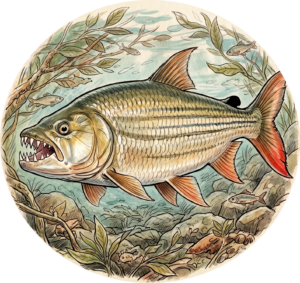
The goliath tigerfish has a streamlined body suited for swift movement in currents, resembling the shape of some tuna species. The upper part of its body has a silvery gray tone, fading to lighter shades on the sides and belly, sometimes with hints of yellow or brown around the head. The goliath tigerfish has a prominent dorsal fin and smaller ventral fins. Adults typically reach lengths of around 1.5 meters and weigh up to 50 kilograms, though there have been reports of species as long as 2 meters and as heavy as 70 kilograms and more.
The goliath tigerfish’s mouth contains sharp, conical teeth that interlock between the jaws, with counts ranging from 12 to 20 in the upper jaw and 8 cm to 14 cm in the lower. Each tooth can measure up to 2.5 centimeters, and the fish replaces them in groups every few days to ensure it has sharp enough teeth to attack. Additional teeth in the throat area aid in processing food, similar to those in certain sharks.
Distribution and Habitat of the Goliath Tigerfish
The goliath tigerfish is found in the Congo River system in central Africa, covering areas in the Democratic Republic of the Congo and the Republic of the Congo. Key locations of the goliath tigerfish include the main Congo River, the Lualaba River, Lake Upemba, and Lake Tanganyika. Geological features like river knickpoints may have influenced its range by blocking upstream movement in the past. The goliath tigerfish prefers habitats with high oxygen levels and strong flows, such as deep channels in rivers or open sections of lakes. The goliath tigerfish lives in tropical waters, generally between 23 and 26 degrees Celsius, with a neutral to slightly alkaline pH. The goliath tiger fish swims in pelagic zones, meaning it swims in open water rather than near the bottom. Related species in the genus show similar preferences but cover broader areas, and ecological studies emphasize how habitat fragmentation from dams or pollution could affect populations, though specific data for H. goliath remains limited.
Other Tigerfish Species Across Africa
While Hydrocynus goliath dominates discussions of African tigerfish due to its massive proportions, the genus includes several other species spread across the continent, each adapted to specific river basins and ecological niches. These different tigerfish share core traits like predatory lifestyles and sharp teeth but differ in size, appearance, distribution, and behaviors, reflecting millions of years of evolutionary divergence tied to Africa’s changing landscapes.
Genetic studies reveal at least ten distinct lineages within the tigerfish genus, including five cryptic ones that may warrant recognition as separate species, underscoring hidden diversity shaped by ancient geological events such as rifting and river captures. This variety highlights how tigerfish evolution has mirrored the reconfiguration of drainage systems during the Neogene period, from the late Miocene to the Plio-Pleistocene, roughly 16 million years ago to recent times.
For example, major splits in lineages occurred around 6.8 million years ago, separating groups like the one leading to H. brevis and H. forskahlii, while others emerged later in response to tectonic shifts in the East African Rift System and Central African Rift Zone. These events altered water flows, isolated populations, and facilitated dispersals, resulting in the current patchwork of species across 23 principal rivers in 15 drainage basins. Absent from certain areas like Lake Victoria or Lake Malawi east of the Albertine Rift, tigerfish distributions emphasize vicariance—splitting of ancestral ranges—and occasional connections between basins like the Nilo-Sahelian system.
Hydrocynus vittatus
One prominent relative is Hydrocynus vittatus, often simply called the African tigerfish, which inhabits a vast swath of southern and eastern Africa. This species reaches up to 105 centimeters in standard length and weighs around 15 to 20 kilograms at maturity, making it considerably smaller than the goliath tigerfish’s potential 70-kilogram bulk. Its body appears more elongated and robust, with a silvery base overlaid by distinct thin black horizontal stripes along the flanks, unlike the minimal or absent striping on the goliath tigerfish
The caudal fin has red with black edging, and the head is large, with eight conical teeth per jaw that replace simultaneously every few days —fewer than goliath tigerfish’s 12 to 20 upper teeth. Males grow larger and fuller-bodied than females, a dimorphism not as pronounced in the goliath tiger fish’s records. Habitat-wise, the African tigerfish favors the bottoms of large rivers and lakes with high oxygen, moving surfaceward by day and deeper at night, contrasting the goliath tigerfish’s preference for fast-flowing pelagic zones.
The African tigerfish’s range spans systems like the Zambezi, Okavango, Limpopo, Niger, Nile, Congo, and Lake Kariba, overlapping slightly with the goliath tigerfish in the Congo but extending far south to the Pongola River. Behavior includes schooling in juveniles of similar sizes, solitary hunting in adults, and migrations up to 100 kilometers, potentially more flexible than the goliath tigerfish’s patterns tied to turbulent waters. The African tigerfish’s diet centers on available fish like cichlids, gobies, carp, and catfish, supplemented by insects and zooplankton, but uniquely, some populations jump to snatch barn swallows in flight with a 25 percent success rate, a feature unobserved in the goliath tiger fish.
The African tigerfish’s reproduction involves spawning in December or January amid rainy-season floods, with eggs laid in shallow vegetated shores and no parental care, similar to the goliath tigerfish, but possibly with shorter maturation times given the smaller size. Conservation status lists it as least concern overall, though declines occur from pollution, dams blocking migrations, overfishing, and agricultural runoff in southern rivers. The African tigerfish is protected in South Africa and in reserves like Kruger National Park, where studies track its rarity and ecological role. Genetic analyses place H. vittatus in a “vittatus complex” with three cryptic lineages (Groups B, C, D) from areas like Lake Tanganyika, Mweru, and Bangweulu, showing high haplotype diversity and population structuring—97.4 percent variation among groups—unlike the goliath tigerfish’s more isolated oldest lineage. Economically, it supports fisheries and tourism, with angling records at 35 pounds, far below the goliath tigerfish’s records and populations divided into four genetic groups awaiting subspecies designation.
Hydrocynus forskahlii
Further west and north, Hydrocynus forskahlii, or the elongate tigerfish, occupies Sahelo-Sudanese basins including the Nile, Chad, Niger, Volta, Senegal, and Gambia. It grows to about 80 centimeters and 10 kilograms, slimmer and shorter than both the goliath tigerfish and the African tigerfish. Appearance features a silvery white tone with dramatic striping, a small straight head, and a red tail coloring both lobes, differing from the goliath tigerfish’s red only on the bottom lobe and larger head.
Teeth number 9 to 14 upper and 8 to 12 lower, often with an upturned jaw, and anal fin rays total 3 unbranched and 12 to 13 branched, matching the goliath tigerfish, but with a lower lateral line. Habitats overlap with H. brevis in northeastern Africa, focusing on pelagic tropical waters, but ecological comparisons show it coexists with African pike (Hepsetus odoe), partitioning resources during high and low water season. H. forskahlii takes more pelagic prey while pike hugs shores.
Behavior leans piscivorous with some caridina and insects, potentially less aggressive than the goliath tigerfish’s ambush style. Distribution ties to ancient connections like the Nilo-Sahelian, with genetic data revealing a “forskahlii complex” including cryptic Group E from Cameroon’s Sanaga River, showing sister relationships and Plio-Pleistocene origins. Unlike the goliath tigerfish, this species spans broader arid-adjacent zones, facing threats from water extraction but rated least concern. Angling records hover around 12 to 28 pounds.
Hydrocynus brevis
Hydrocynus brevis, another northern tigerfish species, resides in similar Sahelo-Sudanese rivers like the Nile, Chad, Niger, Volta, Senegal, and Gambia, often sympatric with H. forskahlii. It attains 86 centimeters total length and 8.3 kilograms, with a fusiform, massive anterior body, grey or black adipose fin, and red-orange hues on the caudal lower lobe and anal fin front. Distinct from H. goliath, it has three scale rows between the lateral line and pelvic-fin base (versus variable in others), a large adipose fin relative to body, and silvery or golden shine with little striping. Lateral line scales number 47 to 55, higher than H. forskahlii but overlapping goliath tigerfish slightly.
It migrates within rivers, feeding piscivorously with insects and caridina, similar diets but in drier climates. Evolutionary placement shows it diverging around 6.8 million years ago, with shared haplotypes across distant rivers indicating recent dispersals via paleoconnections. Conservation deems it least concern, harmless to humans, but potential vulnerabilities from habitat changes exist. Differences from the goliath tigerfish include smaller size, thicker build, and northern range without the central rapids preference.
Hydrocynus tanzaniae
In eastern Africa, Hydrocynus tanzaniae populates Tanzania’s Rufiji and Ruaha watersheds, growing to 24.7 centimeters standard length in females—among the smallest in the genus—and weighing modestly. Its greyish body shows pronounced striping, a blue or green tail on both lobes, and a dark steel blue adipose fin, contrasting the goliath tigerfish’s silvery minimal stripes and bottom-lobe red. Its head length is 18.3 to 22.2 percent of body, with 13 to 16 upper teeth and 10 to 12 lower, and elongated third/fourth dorsal/anal rays.
It is pelagic in tropical freshwaters and exhibits high resilience with quick population doubling under 15 months. Rated least concern since 2006, it’s harmless and faces no specified threats. Genetic ties place it sister to the vittatus complex, originating in the Pliocene, with unique adipose traits noted in Tanzanian catches over 25 pounds, though IGFA lacks records. Compared to the goliath tigerfish, it’s far tinier, more striped, and restricted eastward, with potential for larger individuals in fly-fishing contexts. Cryptic lineages like Group A in the Congo (Kwango, Lulua) add layers, showing independent histories and possible sympatry, urging further morphological and ecological probes to refine distinctions.
Behavior and Hunting Strategies of the Goliath Tigerfish
Behaviorally, goliath tigerfish individuals often hunt alone but gather in groups during migration for spawning. Goliath tigerfish excel as swimmers, navigating turbulent waters to pursue targets. Ambush tactics involve hiding in quieter spots along edges of fast currents, then striking suddenly. Vision plays a key role in spotting prey, supplemented by sensitivity to low-frequency vibrations in the water. In confined settings like aquariums, they display aggression, making them unsuitable for most keepers. Large tanks over 4,000 liters are necessary for adults, and they cannot coexist with smaller fish due to their predatory instincts. Observations suggest they can form loose schools at times, especially juveniles, but adult goliath tigerfish lean toward solitude. Research on related tigerfish species indicates seasonal movements tied to water levels, with potential implications for the goliath tigerfish in response to flooding or dry periods.
Diet of the Goliath Tigerfish
Feeding focuses on other fish, earning it a reputation as a top carnivore, the goliath tigerfish targets whatever it can overpower, including smaller conspecifics, catfish, cichlids, carp, and gobies. The bite delivers force to tear chunks or swallow whole, with teeth designed for gripping and slicing. In rare cases, the goliath tigerfish may go after larger animals like crocodiles or even humans when food is scarce. The only consistent natural threats come from Nile crocodiles and human activities. Trophic level estimates place it at around 3.8, confirming its position high in the food chain based on diet composition and size. Nutrient profiles from caught specimens show high protein content at about 19.6 percent, along with minerals like calcium, iron, selenium, and zinc, making it valuable as food in local communities.
Reproduction and Life Cycle of the Goliath Tigerfish
The goliath tigerfish’s reproduction occurs near shorelines or riverbanks, where females lay large numbers of eggs—up to 780,000 in a single spawning—amid vegetation for cover. This happens mainly in warmer months, aligned with flooding. Parents provide no care after release, leaving young to fend for themselves. Larvae start on plankton, shifting to small fish as they grow. Development proceeds slowly, with annual increases of four to six inches, requiring up to a decade for maturity. Resilience appears low, with population doubling times estimated at 4.5 to 14 years, influenced by growth rates and fecundity. Captive breeding has not succeeded, so all aquarium specimens come from wild captures. Comparative studies on congeneric species highlight how fishing pressure can alter sex ratios and maturity sizes, potentially applying to goliath tigerfish in overexploited areas.
Goliath Tigerfish: Human Interactions and Cultural Significance
Interactions with people are mostly recreational, but locals sometimes consume it as a protein source, especially dried forms in regions like the Central African Republic, despite storage problems. Sport fishing attracts enthusiasts who view it as a premier challenge due to its fight and elusiveness. Native groups sometimes see it as a symbol of danger, calling it an evil spirit and avoiding it during travels. Reports of attacks on humans exist, though verified instances are rare, often linked to mistaken identity with shiny objects. In media, the goliath tigerfish features in programs like River Monsters, boosting its notoriety. As pets, only experts handle them, given space and diet needs.
Goliath Tigerfish: Consumption and Nutritional Value
People do consume the goliath tigerfish, though not as a staple due to its rarity and the effort required to obtain it. In local communities, it serves as a protein source, often dried or smoked for preservation in areas lacking refrigeration. Nutrient analyses reveal high levels of protein, around 20 percent, plus essential minerals, making it nutritious despite occasional storage issues from pests.
Tribes in the Central African Republic and Congo prepare the goliath tiger fish by grilling over open fires or into stews with vegetables and spices. However, cultural beliefs sometimes deter consumption; some groups label it an evil spirit and avoid eating it to ward off bad luck. Reports from expeditions note villagers eagerly accepting caught specimens for meals, suggesting practical needs override superstitions. In contrast, sport anglers rarely keep it for food, focusing on the thrill instead. Taste descriptions compare it to firm white fish like perch, with a mild flavor when fresh, though bones and toughness require careful preparation.
Goliath Tigerfish: Conservation Status
Conservation lists the goliath tigerfish as Least Concern on international assessments, with the last review in 2009 indicating stable numbers. However, broader threats to African freshwater fish include habitat loss from dams, pollution, overfishing, and climate shifts, affecting 26 percent of species overall. Population sizes remain unquantified, but guidelines encourage catch-and-release of goliath tigerfish in sport contexts to maintain stocks.
Genetic research points to evolutionary adaptations for predation, with teeth replacement ensuring constant efficiency. In folklore, tribes label it a demon fish for its ferocity. Comparisons to piranhas note distant relations but similar reputations, though this species grows much larger. Records of the heaviest at 154 pounds come from unverified sources, but confirmed ones hover around 110 pounds. Its presence in games and simulations further popularizes it among enthusiasts.
Goliath Tigerfish: Fishing Practices
Fishing for Hydrocynus goliath has long captured the imagination of those drawn to extreme challenges in remote waters. This species, confined to the Congo River Basin, presents unique difficulties due to its habitat in turbulent currents.
Records of encounters with the goliath tigerfish date back to indigenous communities in the Democratic Republic of the Congo and the Republic of the Congo, where it earned names like mbenga, symbolizing both fear and respect. Early accounts from explorers in the late 19th century, around the time George Albert Boulenger classified it in 1898, describe it as a formidable presence in oral traditions. Tribes along the river viewed it as a spirit or demon, often avoiding areas where it lurked, but they did pursue it for sustenance when opportunities arose.
Traditional methods involved simple nets, spears, or traps set in calmer eddies, relying on knowledge of seasonal movements during floods. These practices were not recreational but survival-based, with catches shared among villages. Historical texts from colonial eras mention occasional sightings by European travelers, who noted its size and aggression but rarely attempted to catch it, deeming the river too hazardous. By the mid-20th century, as angling gained popularity globally, whispers of this giant reached Western enthusiasts through books and magazines, portraying it as an uncatchable myth. One angler, inspired by childhood readings, spent over 30 years planning a trip, highlighting how literature fueled early interest. In those days, without modern gear, success rates were low, and stories emphasized lost lines or broken rods rather than triumphs.
Local fishermen still use handmade tools, such as woven baskets or baited hooks on sturdy lines, targeting it during high water when it moves closer to shores. Commercial efforts remain small-scale due to the fish’s elusiveness. Modern techniques include trolling with heavy-duty rods, live or dead bait like smaller fish, and artificial lures that mimic prey movements. Equipment must withstand immense force—reels with high drag capacity, lines testing 80 to 100 pounds, and hooks sharpened to penetrate its bony mouth. Dry months offer clear visibility and the best period to fish goliath tigerfish in the Congo is from June to September during the dry seasons.
Sport Fishing in the Congo
Sport fishing for goliath tiger fish, particularly in the Congo, stands out as one of the most demanding pursuits in angling. The river’s vast, untamed stretches demand expeditions that combine adventure travel with skill. Trips often start in Kinshasa, involving a boat journey upstream. You can book tigerfish fishing through our travel agency from Kinshasa. Our agency has a well-equipped fishing camp north of Kinshasa with a professional experienced team and plenty of experience in fishing for goliath tigerfish. We receive a maximum of 3 persons at the time to maintain quality.
Techniques emphasize patience: hours of casting in deep channels, where the fish ambushes from currents. Once hooked, it unleashes powerful runs and leaps, testing tackle to extremes—fights can last over an hour, with the fish using its teeth to sever lines. Catching goliath tigerfish in the Congo is the “ultimate freshwater battle.”
In 2011, British explorer Jeremy Wade’s journey up the Congo documented attacks from goliath tigerfish on humans and crocodiles, culminating in a capture that required navigating treacherous waters with local help. His team faced several challenges like boat breakdowns and more.
Television has amplified its notoriety, with shows venturing into the Congo for dramatic footage. The series River Monsters, hosted by Jeremy Wade, devoted episodes like “Demon Fish” to it, where he caught a specimen after hearing tales of human attacks. Airing from 2009 to 2017, it portrayed the fish as a top predator, with Wade posing alongside a 5-foot example amid village celebrations. He debated killing it for study but released or shared with locals, underscoring ethical dilemmas. A 2014 documentary titled Tigerfish followed Andy Coetzee unraveling truths behind its aggression, filming in similar habitats.